Highlights:
- Why you don’t need to be an expert to successfully self-invest
- How to get expert guidance (without giving away a percentage of your portfolio)
- Make investing feel real by seeing how your money can grow over time
The reason people still work with financial advisors isn’t necessarily what you think.
This study by Morningstar found a major reason for working with a financial advisor is “a lack of confidence in their own skills needed to reach their financial goals or their knowledge regarding finances.”
And I totally get that - I was on the fence about switching from my advisor to self-investing for years.
This article gives you the plan to grow your confidence (and wealth!) with self-investing.

Choose a simple strategy
Most investors only need 3 to 5 funds in their portfolio.
That’s it! It can be this simple.
Instead of picking individual stocks, you can buy ETFs that let you invest in hundreds (even thousands) of companies at once.
This way you’re diversified - even if one industry goes through a rough patch, you have all the others to balance things out.
With just a few ETFs, you’ve basically got the whole world in your portfolio.
Best part, this passive investment strategy is easier - and about 90% of the time, outperforms professionally managed funds.

Understand the basics
When it comes to passive investing, you don’t need a finance degree or years of investing experience.
But having a basic understanding of how things work can help you feel much more confident.
Knowing what an ETF is, how diversification protects you, and why long-term investing matters can help you feel more in control. It takes the mystery (and anxiety) out of investing.
See how to choose 3-5 funds to have a portfolio that works over the long run. All you need to do is keep putting more money in regularly.
Once you know the fundamentals, you’ll feel more confident about self-investing (and stress less when headlines get scary).

Don’t get hung up on the future
I see people getting stuck because they worry about what they’ll do as they get closer to retirement.
This is something you’ll figure out in 20+ years from now. Don’t let it stop you from getting started!
All you need is the general idea. If you get too specific, chances are the plan will have changed by then anyway.
Having a session with a fee-only financial advisor when you are 5-10 years from retirement is a good way to create your plan for the next stage.
For now, here’s the gist:
- As you near retirement, create more stability by shifting towards a higher percentage of bonds
- RRSPs eventually get converted to RRIFs, and the minimum you can withdraw is set by the government
- TFSAs can grow tax-free as long as you live
- You'll draw down your accounts at different stages, depending on income, taxes, and government benefits

Do projections
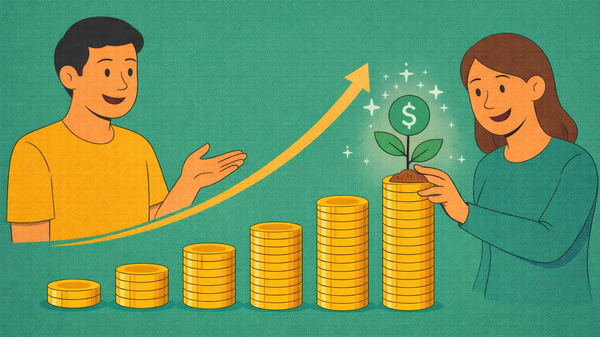
Investing feels a lot more ‘real’ and exciting when you see what it’s leading to!
Use a compound interest calculator and run different scenarios.
What happens if you invest $50 a month? $100? $1000?
Try it with an average annual return of 7% or 8%. That's what many investors use to estimate long-term stock market growth.
You’ll be surprised at how much even small, consistent amounts can grow over time.
It’s one thing to know compound interest is powerful - it’s another to see your future numbers laid out.
And it helps you make decisions now that determines what your retirement looks like!

Have a plan
One of the best ways to feel more confident with self-investing is to have a clear plan that fits your life - your income, goals, and timeline.
A fee-only financial advisor can help you create a clear plan, and many also provide DIY investing support.
This was an absolute game-changer for my husband and myself - and was also what gave me the courage to start self-investing.
Our advisor was key for helping us come up with a tax-efficient plan so we knew how much to invest and which accounts to use.
It was so helpful having a step-by-step plan that takes our entire financial situation into account - from pensions, to real estate, to investments.
A fee-only advisor costs a bit more upfront because you have to pay out of pocket, but can save tens of thousands (or much more!) in the long run.
Once you have a solid plan, you can confidently invest on your own using low-fee index ETFs instead of handing your money over to an investment advisor that charges ongoing fees.

Update the plan as needed
Your investment strategy might change a bit as life goes on.
Any time you go through a major transition, it’s worth doing a check-in.
Buying a home, having a baby, changing jobs, retiring - these all affect your income, expenses, risk tolerance, and goals.
We like to book a one-hour session with our fee-only advisor whenever there’s a big change.
It gives us a chance to ask questions, revisit our numbers, and can make minor changes to our plan so it fits where we’re heading.
For example, we recently had a session where our big focus was deciding what to do now to reduce our taxes in retirement.

Use a planning tool
If you want to get even more specific, you can use a planning tool like Gilded that takes your entire financial picture into account.
This is cool because it accounts for the whole overview of our finances, at every stage - including pensions, CPP, OAS, RRIF withdrawals, taxes, and cost of living adjusted for inflation.
You can also run different scenarios and see how it will affect your financial future.
Now you get to really “see” where things will be at. It gives a good idea if you’re on track, or if you should make some adjustments.

Start slow & celebrate progress
When I first started self-investing, I started with a few thousand dollars to get my feet wet.
As I got more comfortable with the process (and realized how easy it truly is!), I started investing more and more.
It took me a few months to finally move everything into my self-directed accounts, cut ties with my investment advisor, and invest entirely on my own.
Celebrate every step of the way - whether that’s contributing $50 into your TFSA, choosing your portfolio, setting up your Passiv account - every step counts!
And when I say celebrate your progress, I mean actions you take - don’t use the amount in your investments as the gauge. That can go up and down depending on the day.
Consistency and time in the market are 2 of the biggest factors that lead to investing success, so developing the habit is your goal.

Confidence comes from doing
Researching and planning are great, but what will really grow your confidence with investing is actually just doing it.
This is where all the pieces come together - and the longer you invest, the more confident and at ease you become.
The more you see, the more you realize it’s just a cycle that repeats itself - the market dips, you ride it out, and things recover.
If you’re invested in solid ETFs, you just keep investing.
And Passiv makes it easy to stay consistent.
It alerts you when there’s cash to invest, tells you what to invest in, and keeps your portfolio on track.
So let’s get started! Click here to get the Forever Free version of Passiv and grow your confidence and investments.