Highlights:
- Your first $1,000 does not need a complicated investment strategy.
- The most important decision happens before you choose what to invest in.
- What you do with the next $1,000 matters more than finding a “perfect” first investment.
You’ve saved your first $1,000 to invest, which is exciting. It can also be the point where things suddenly feel more complicated than they need to.
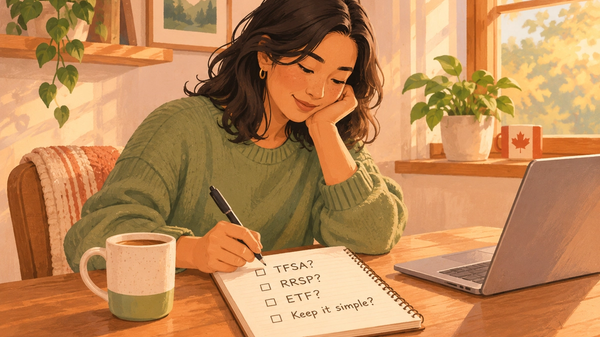
Should it go in a TFSA or RRSP? Do you need to pick stocks? Is one ETF enough? And what if you choose the wrong thing?
You don’t need to solve every investing question before you get started. For your first $1,000, focus on a few basic decisions: what the money is for, how long you can leave it invested, which account makes sense for that goal, and a simple investment plan you can keep adding to.


First, should this $1,000 be invested at all?
Before choosing an account or an investment, ask yourself one question:
When might I need this money?
If this is money you may need soon, or money you would rely on in an emergency, putting it into investments that can fall in value may not make sense.
The Ontario Securities Commission’s investor education site explains that the amount of time before you need your money is an important part of deciding how much investment risk makes sense. Money needed sooner has less time to recover if markets fall.
You do not need to calculate an exact “time horizon.” Just think about it in normal language:
- Could I need this next year?
- Is this for something five years away?
- Is this money for retirement decades from now?
If the $1,000 is genuinely long-term money, you can move on to the investing decisions.
What are you investing the $1,000 for?
The answer does not have to be complicated.
Maybe it is for:
- retirement
- a home later in life
- long-term financial freedom
- building wealth for the future
Knowing the goal helps with the next two decisions: which account to use and how much risk makes sense.
For example, money for retirement in 25 years is very different from money you expect to use for a home in three years.
You do not have to know exactly what your life will look like decades from now. You just need a reasonable idea of what job this money has today.


Should your first $1,000 go in a TFSA, RRSP or FHSA?
There is no account that is automatically best for everyone.
Here is the simplest way to understand the main options.
TFSA
A TFSA can be used for many different savings and investing goals.
You do not get a tax deduction when you contribute, but investment income and withdrawals are generally tax-free.
That flexibility is one reason many Canadians use a TFSA for long-term investing.
RRSP
An RRSP is designed for retirement savings.
Eligible RRSP contributions can reduce your taxable income. Your investments generally grow without annual tax while they remain inside the plan, and withdrawals are generally taxable later.
FHSA
If you are an eligible first-time home buyer, an FHSA is designed to help you save for a qualifying first home.
Contributions are generally tax deductible, and qualifying withdrawals can be tax-free.
Taxable account
You can also invest outside a registered account.
The tradeoff is that investment income such as interest and dividends, and gains from selling investments, may create tax reporting.
You do not need to become a tax expert before investing. Just understand that the account matters because the tax rules are different.
If you already have money spread across different account types, Passiv also has a guide to managing your TFSA, RRSP and taxable account together.
What should a beginner actually invest in?
This is usually the part that feels intimidating. There are thousands of stocks, ETFs and other investments to choose from, but you do not need a complicated portfolio to get started.
An ETF, or exchange-traded fund, is a single investment that can hold many stocks or bonds inside it. That can make it easier to spread your money across lots of investments without picking individual companies yourself.
If ETFs are completely new to you, Passiv has a beginner-friendly guide that explains what an ETF is.
Not every ETF is broadly diversified, though. Some focus on one industry, country or investment strategy, so you still need to understand what you’re buying.
For a simple passive-investing approach, many DIY investors use a small number of broad ETFs rather than trying to pick individual winning stocks.
Passiv also has a guide explaining why a simple ETF portfolio can be enough for many Canadian investors.
You still need to choose a mix that fits your goal and how comfortable you are seeing your investments move up and down.

You do not need to make your first $1,000 complicated
It can be tempting to think that owning more investments means you have a better portfolio.
Before long, you might be considering:
- a Canadian ETF
- a U.S. ETF
- a technology ETF
- a dividend ETF
- a few individual stocks
- whatever you saw someone talking about online
Now your first $1,000 has turned into six decisions you have to keep managing.
There is nothing wrong with owning several investments if there is a reason for each one. But a simple portfolio is not something you need to grow out of. If one or a few broad funds give you the diversification and mix you want, you can keep using that approach for years.
If your investment plan only needs one or a few broad funds, $1,000 is enough to start following that plan.
Your first portfolio does not need to impress anyone. It needs to make sense to you.
What if you are scared of choosing the wrong thing?
A lot of new investors hesitate here because they feel like they need to know more before they can begin.
In practice, confidence often grows once investing stops feeling unfamiliar.
Passiv’s guide on becoming a confident self-investor goes deeper into starting small, keeping things manageable and getting more comfortable making your own investing decisions.
You can also change your investment plan later. Starting with $1,000 does not lock you into the same portfolio for the rest of your life.
Your goals may change. Your income may change. You may learn more and decide a different mix fits you better.
If your life does change, that can be a good reason to review the plan itself, not just whether your investments still match it.


The next $1,000 matters too
Making the first investment can feel like the big milestone. Once that is done, the more useful question is what you will do when more money becomes available.
Maybe you can invest $50 a month, $200 every payday, or a larger amount whenever you get a bonus. The amount does not have to be the same forever.
What helps is having a process you can repeat.
That might mean adding money when you can, checking your target portfolio, and putting the new cash toward the investments that need it.
Then you can get on with your life instead of rebuilding your investment strategy every time you make a deposit.
This is where Passiv becomes useful
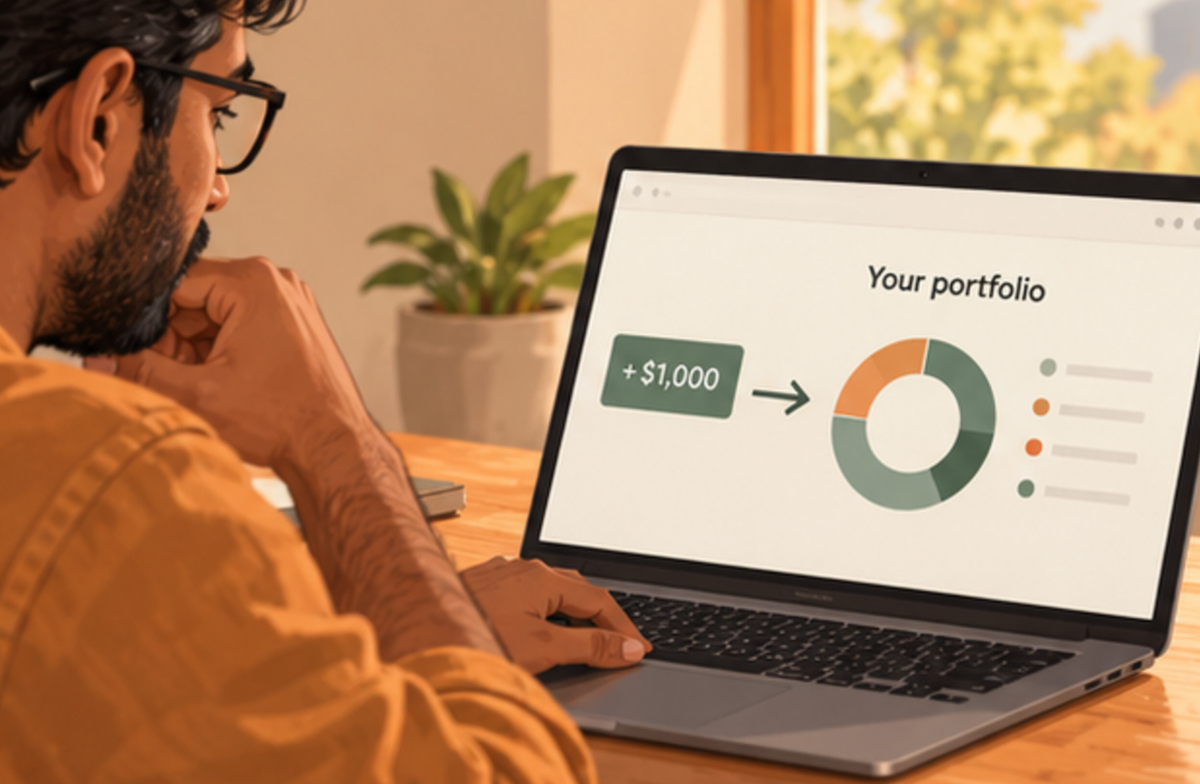
If you already use Passiv, your model portfolio is the target you have chosen for your investments.
You tell Passiv which investments you want to hold and the percentage you want in each. Passiv then compares what you own with that model and calculates trades that would move the portfolio closer to your target.
So when your next deposit arrives, you do not have to sit down and work everything out again.
You already chose the plan. Passiv can handle the recurring calculations.
Its current Community plan is $0 per month and includes automated calculations.

Your first $1,000 is the start of a system
There can be a lot of pressure around making your first investment because it feels like you need to get everything right immediately.
You don’t.
Start by figuring out what the money is for, when you are likely to need it, which account fits that goal, and what simple portfolio you want to follow.
Then keep adding to it when you can.
If you already have Passiv set up, check that your model portfolio still reflects the plan you want before investing the cash. Once it does, Passiv can take care of the calculations each time new money arrives.
The goal is for investing your next $1,000 to feel much easier than investing your first.